No Declared Stingrays in Allegany County

14934179479141746285699

No Declared Stingrays in  Allegany County

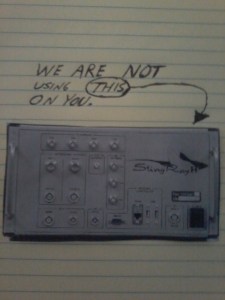
Across the United States, law enforcement agencies have being using devices, commonly called “Stingrays,” to conduct surveillance on civilian populations.  These devices are purported to mimic cell phone towers to track phones and, potentially, intercept communications and other content.  

Imagine a device, small enough to fit inside a car.  The device is put inside a police vehicle and driven through your neighborhood.  As it approaches your home, your phone breaks its link with your cell phone service provider’s tower.  Your phone, without any interruption in service, latches on to the Stingray in the police car, thinking it’s a legitimate tower.  You are able to make and receive calls, texts, and otherwise use your phone.   However, the government is in a position to locate your phone and potentially intercept other information from it.  

In March, the Western Maryland Criminal Defense Attorneys Association sent letters under the Maryland Public Information Act to law enforcement in Allegany County.  The letters requested information related to cell site simulators used by these agencies.  Below is a draft of this letter, along with responses from the Allegany County Narcotics Task Force, the Allegany County Sheriff’s Office, the Allegany County Combined Criminal Investigation Unit (C3I), Cumberland City Police Department, and the Office of the State’s Attorney for Allegany County.

In short, these agencies deny knowledge of, participation with, and/or responsibility for the usage of such devices in Allegany County.

Draft WMCD MPIA Request

WMCD MPIA Responses

-Article by Paul J. Notarianni,  presented at the request of the Western Maryland Criminal Defense Attorneys Association.

See further:

Wikipedia: Stingray_Phone_Tracker

The Baltimore Sun: Maryland lawmakers hear arguments over police surveillance technologies

ACLU: Stingray Tracking Devices: Who’s got them?

Posted in - Public Interest, ---- Paul Notarianni | Tagged , , , , , , , , , , , , , , , , , , , , , , , , , , , , , , | Comments Off on No Declared Stingrays in Allegany County

Is 4th Degree Burglary Impeachable?

1493341048023783989770

Short Answer:  

Generally,  in and of itself, a prior conviction for a violation of CR 6-205 (a), (b), or (d) is not valid impeachment material. This is not the case for a conviction for CR 6-205 (c).

Long Answer:  

Depending on the specific subsection of Maryland Criminal Law Section 6-205, a criminal defendant may be subject to impeachment for a prior conviction.   CR Section 6-205 encompasses four different misdemeanor offenses: a) “a person may not break and enter the dwelling of another;” b) “a person may not break and enter the storehouse of another;” c) “a person, with the intent to commit theft, may not be in or on the dwelling or storehouse of another or a yard, garden, or other area belonging to the dwelling or storehouse of another;” and d) “a person may not possess a burglar’s tool with the intent to use or allow the use of the burglar’s tool in the commission of a violation of [6-205 a, b, or c].” (Id. at a, b, c, and d.)

In Bane v. State, the Maryland Court of Special Appeals addressed the impeachment value of misdemeanor breaking and entering. (73 Md. App. 135 (1987)). The court held in Bane, “misdemeanor breaking and entering involves no felonious or larcenous intent… [in the absence of substantial facts from the underlying conviction to indicate otherwise] …  the conviction of breaking and entering does not necessarily indicate such ‘base or vile’ conduct as would constitute it a crime of moral turpitude. We hold, therefore,  that it is not an offense involving such moral turpitude that evidence of a conviction may be used for impeachment purposes. ” (Id at 150).  The court went on to find that “statutory breaking and entering is [not] among those lesser violations having ‘some tendency to show that the person charged is not to be believed under oath.'” (Id at 151 quoting Cousins v. State, 230 Md. at 4).  This is due to the fact that “the offense of statutory breaking and entering lacks the proof of any conduct that ‘could lead a rational person reasonably to conclude that one who would commit such a crime would be less likely to speak the truth than one who would not commit such a crime.'” (Id. quoting Burrell v. State, 42 Md. App. at 140).

Under Bane v. State, a criminal defendant should not be subject to impeachment for prior conviction, in and of itself, for violation of CR 6-205 (a) or (b) because the language of the statute deals only with breaking and entering.   Likewise, a prior conviction, without additional facts, for CR 6-205 (d) does not, on its face, generate impeachment value.  However, this is not the case with CR. 6-205 (c), whose language does include intent to commit a theft, a crime of moral turpitude,  making it ripe for impeachment.

Practitioner Note One: CR 6-205 (f) states “a person who is convicted of violating 7-104 of this article may not also be convicted of violating subsection (c) of this section based on the act establishing the violation of 7-104 of this article.”

Practitioner Note Two: Bane at 151-52 contains the following string citation: other “offenses that cannot be used for impeachment. See, e.g., State v. Duckett, 306 Md. 503, 510 (1986) (assault and battery); Lowery v. State, 292 Md. 2, 437 (1981) (per curiam) (possession of barbiturates); Ricketts v. State, 291 Md. 701 (1981) (indecent exposure); Nesbit v. Cumberland Contracting Co., 196 Md. 36, 75 (1950) (traffic violations including reckless driving,  passing on a curve,  failing to stop at a stop sign, and driving without a license or after license is revoked); Nelson v. Seiler, 154 Md. 63 (1927) (exceeding the speed limit and driving without a license in one’s possession); Paschall v. State, 71 Md. App. 234, 524 (1987) (malicious destruction); Matthews v. State, 68 Md. App. 282 (1986) (prostitution); Cason v. State, 66 Md. App. 757, (1986) (heroin possession); [and] Woodell v. State, 2 Md. App. 433, 439 n. 2 (1967) (a court martial conviction for disobeying a superior officer while in the military)…”

Posted in - Criminal Law, - Evidence | Tagged , , , , , , | Comments Off on Is 4th Degree Burglary Impeachable?

Imperfect Self-Defense Jury Instruction

14933403976091379745545

NOTE:  This is a sample jury instruction for imperfect self-defense for a charge of First Degree Assault.  It is a modified version of Maryland Pattern Jury Instruction Cr 5:07, Self-Defense,  with additional language pursuant to Christian v. State, 405 Md. 306 (2008).   

MODIFIED JURY INSTRUCTION (IMPERFECT SELF-DEFENSE)

You have heard evidence that the defendant acted in self-defense. You must decide whether this is a complete defense, a partial defense, or no defense in this case.

In order to convict the defendant of First Degree Assault, the State must prove that the defendant did not act in either complete self-defense or partial self-defense. If the defendant did act in complete self-defense, the verdict must be not guilty. If the defendant did not act in complete self-defense, but did act in partial self-defense, the verdict should be guilty of Second Degree Assault and not guilty of First Degree Assault.

Self-defense is a complete defense, and you are required to find the defendant not guilty, if all of the following four factors are present:

(1) the defendant was not the aggressor;

(2) the defendant actually believed that he was in immediate and imminent danger of bodily harm;

(3) the defendant’s belief was reasonable; and

(4) the defendant used no more force than was reasonably necessary to defend himself in light of the threatened or actual force.  

In order to convict the defendant of Assault the State must prove that self-defense does not apply in this case. This means that you are required to find the defendant not guilty, unless the State has persuaded you, beyond a reasonable doubt, that at least one of the four factors of complete self-defense was absent.

Even if you find that the defendant did not act in complete self-defense, the defendant may still have acted in partial self-defense.

If the defendant actually believed that he was in immediate and imminent of bodily harm, even though a reasonable person would not have so believed, the defendant’s actual, though unreasonable, belief is a partial self-defense and the verdict should be guilty of Second Degree Assault rather than First Degree Assault  OR

If the defendant used greater force than a reasonable person would have used, but the defendant actually believed that the force used was necessary, the defendant’s actual, though unreasonable, belief is a partial self-defense and the verdict should be guilty of Second Degree Assault rather than First Degree Assault.  

Posted in - Assault & Affray, - Criminal Law, - Jury Instructions | Comments Off on Imperfect Self-Defense Jury Instruction

Elements of Affray and defenses. Dashiell v. State.

14923509448691552913892-e1492394121118

Brief Brief Dashiell v. State, 214 Md. App. 684 (2013)

Issue: Elements of Affray and defenses.

Background: Defendant was convicted of involuntary manslaughter.  On appeal, three issues were raised: 1) whether the trial court erred in instructing the jury that self-defense is not a defense to affray; 2) whether the trial court erred in allowing the jury to consider affray as an unlawful underlying act for involuntary manslaughter because the State failed to show that the fight occurred in public or caused terror to the people; and 3) whether the trial court erred in refusing to instruct the jury that defense of property may be a defense to assault and affray.  Case was reversed and remanded due to issue one.  Issues two and three discussed due to probability of retrial. Id. at 688.

Quotes:

“An ‘affray,’ a common law offense, has been defined as ‘the fighting together of two or more persons, either by mutual consent or otherwise,  in some public place, to the terror of the people.’” Id. at 689 citing Hickman v. State, 193 Md. App. 238, 248 (2010).

“To establish an affray,  the State need only show that the acts and surrounding circumstances were ‘likely to strike terror in anyone,’ not that it actually has in any specific individual.” Id. at 691 citing State v. Schlamp, 390 Md. at 737.

“Self-defense… may be invoked as a defense to affray.” Id. at 691.

“There are two ways a fight may be deemed ‘mutual’ for the purposes of affray.  To be found guilty, a person ‘must be unlawfully fighting,  either by agreement,  or have brought the fight himself.’  But whether ‘mutuality’ means that there was an agreement to fight or that the accused provoked the fight, mutuality remains a question of fact and thus falls within the provenance of the finder of fact.” Id. at 695 citing Atkins v. State,  421 Md. 434, 443 (2011).

“It is incumbent,  upon the trial court, upon request,  to instruct the jury regarding self-defense,  whenever that issue s generated by the evidence.” Id. at 695.

Posted in - Assault & Affray, - Criminal Law, -- B.B.'s. Brief Briefs | Tagged , | Comments Off on Elements of Affray and defenses. Dashiell v. State.

Standard for Preventative Detention. Wheeler v. State.

14923509448691552913892-e1492394121118

Brief Brief Wheeler v. State, 160 Md.App. 566 (2005)

Issue:  Bond hearing preventative detention.

QUOTE:

“It is often stated that “[t]he setting of bail is within the sound discretion of the trial court.” See e.g., Sykes v. Warden, 201 Md. 662, 662, 93 A.2d 549, cert. denied, 345 U.S. 937, 73 S.Ct. 799, 97 L.Ed. 1364 (1953). While that statement is accurate with respect to the judicial officer’s selection of appropriate conditions of release, the decision to impose “preventive detention” does not involve the exercise of “discretion.” As stated above, “preventive detention” based on the fact that the defendant poses a danger, requires proof of that fact by “clear and convincing” evidence. Unless persuaded by clear and convincing evidence that the defendant is a danger to another person or to the community, a judicial officer does not have “discretion” to conclude that the defendant is too dangerous to be released pending trial.”  Id. at 580.

Practitioner Note: To be clear and convincing, evidence should be “clear” in the sense that it is certain, plain to the understanding, and unambiguous and “convincing” in the sense that it is so reasonable and persuasive as to cause one to believe it. 

Posted in - Bail, - Criminal Law, -- B.B.'s. Brief Briefs | Comments Off on Standard for Preventative Detention. Wheeler v. State.

STETs are Plea Agreements. State v. Thompson.

14923509448691552913892-e1492394121118

Brief Brief State v. Thompson, 48 Md. App. 219, (1981)

Issue:   STET agreements are enforceable plea agreements.

QUOTES:

“Entering of a stet in exchange [for conditions by Defendant] is a plea bargain to be honored by the State as long as the Defendant makes a good faith effort to perform his part.” Id. at 221.

“A plea bargain, by any other name, remains a plea bargain.  It is the substance of the agreement, not the name it is given, to which we look in order to determine whether a pact was struck . . . and once the State has made a bargain, it is bound to adhere to the agreement so long as the accused performs his part, and we eschew the State’s attempt by semantics to renege on its covenant  [i.e. of “STET” versus guilty plea].” Id. at 222.

“The office of the State’s Attorney is a public trust.  The awesome power, vested by the people in the State’s Attorney, should not be employed for the purpose of applying balm to a wounded ego or to the fulfillment of a personal vendetta.”  Id at 222-223.

Posted in - Criminal Law, - Plea Agreements, -- B.B.'s. Brief Briefs | Comments Off on STETs are Plea Agreements. State v. Thompson.

DWS Mens Rea. State v. McCallum.

14923509448691552913892-e1492394121118

Brief Brief: State v. McCallum 321 Md. 451 1990 

Issue: Mens Rea for driving while suspended.

QUOTES:

if the State offers the record at any subsequent trial and there is an objection, the court should redact all portions of McCallum’s motor vehicle record which are not relevant to the charge at issue.” Id at 453

“we agree, that mens rea is required for the offense of driving while suspended, and that the trial judge erred in failing to so instruct the jury” Id. at 455

Deliberate ignorance requires a conscious purpose to avoid enlightenment; a showing of mere negligence or mistake is not sufficient. Also, “deliberate ignorance” is a form of knowledge, not a substitute for knowledge. Therefore, if McCallum actually believed that his driver’s license was not suspended, he could not be guilty of the offense.I believe McCallum would have the required mens rea in the instant case if he was deliberately ignorant of his suspension. Deliberate ignorance should be established if McCallum believed it was probable that his license was suspended and if he deliberately avoided contact with the MVA to evade notice. For example, the trier of fact could find that: 1) based on his failure to pay district court fines and failure to appear in court, McCallum knew that it was probable that his license was suspended; 2) McCallum failed to fulfill his obligation to keep MVA apprised of his current address, or that he failed to contact MVA after learning that for several months his mail was destroyed, and 3) McCallum deliberately avoided contact with MVA to avoid receiving notice of the suspension of his driver’s license. These findings should justify a conclusion that McCallum’s intentional avoidance of notice of his suspension satisfied the mens rea requirement and was the equivalent of actual knowledge of his suspension.” Id at 461-62

Posted in - Criminal Law, - Traffic Offenses, -- B.B.'s. Brief Briefs | Comments Off on DWS Mens Rea. State v. McCallum.

Considering Other Pending Cases at Bail. Bigley v. Warden of Maryland Correctional Facility for Women.

14923509448691552913892-e1492394121118

Brief Brief:  Bigley v. Warden of Maryland Correctional Facility for Women, 16 Md. App. 1 (1972)

Issue: Courts taking into consideration other pending criminal cases while affixing bail in another.

Procedural Posture:  Case was a Habeas Petition out of the Circuit Court of Baltimore, who denied relief regarding bail pending appeal.  Court of Special Appeals denied relief.   See Generally Id.

Facts: “Patricia Ann Bigley and Tyrone Earl Fleming, applicants, were both convicted in the Circuit Court for Baltimore County on May 16, 1972, of two violations of the narcotic laws of this State. Each was sentenced to a total of six years imprisonment by Judge Kenneth C. Proctor. Immediately following the sentencing, counsel for Bigley and Fleming requested the trial judge to ‘consider setting an appeal bond.’ The request was denied. Subsequently, on June 1, 1972, an ‘application for bail’ on behalf of applicants was heard, considered, and denied by Judge Proctor. Thereafter, applicants sought relief in the Court of Appeals of Maryland from the denial of bail. That Court, on June 30, 1972, dismissed the application,” with leave to file in proper appellant court, Court of Special Appeals. Id. at 3.

QUOTES:

“‘Generally speaking, it may be said that, in an ordinary criminal case, other than for a capital offense, an accused, after as well as before conviction, and pending the consideration of the final hearing of his case in the appellate courts, is entitled to bail. There may be unusual cases, arising either from the nature of the offense, or the character of the defendant, that would warrant the court to hesitate in granting bail; but these are exceptional cases, and presumptively the right to bail exists, and ought to be granted an accused.”  Id. at 10-11 quoting Jones v. United States, 12 F.2d 708 (4th Cir. 1926),

“We think that the judge could properly consider the indictments pending against the applicants because those indictments, coupled with the instant conviction, cumulatively enhanced the possibility of punishment and proportionately increased the potentiality of flight. Of course, in fixing bail in respect to a particular offense before trial,  the court may not consider other charges pending against an accused, except as lawfully provided in Article 27, Section 616 ½.”  Emphasis added, Id. at 13.

Practitioner Note:  Article 27 Section 616 ½  is encompassed in CP Section 5-202: Escape; Drug Kingpin (CR Section 5-613); Crime of Violence; arson in 1st degree; burglary 1st 2nd 3rd, child abuse under Criminal Law 3-601 0r 3-602; crime related to destructive device under Criminal Law 4-503; manslaughter by vehicle under Criminal Law 2-209.  

Posted in - Bail, - Criminal Law, -- B.B.'s. Brief Briefs | Comments Off on Considering Other Pending Cases at Bail. Bigley v. Warden of Maryland Correctional Facility for Women.

Spreadsheets = Hearsay. Davies v State.

14923509448691552913892-e1492394121118

Brief Brief: Davies v State 198 Md App 400 (2010)

MD Rule 5-1006

Issue:  If a party seeks to present voluminous data in a more convenient form for trial (in this case, a spreadsheet of stolen property); it must make the materials used to compile the spreadsheet available to opposing counsel.  See Generally Id.

Background: Defendant was convicted by jury of several theft charges from his former employer.  At trial, State offered into evidence, over Defense objection, a spreadsheet of the stolen property where the Defense was not permitted to view or subpoena the creator of the underlying data used to compile the spreadsheet. The Court of Special Appeals held that: 1 State’s exhibit, should not have been admitted because it did not satisfy evidence rule MD 5-1006; and 2 circuit court abused its discretion in quashing defendant’s subpoena of records of his employer because, by doing so, court denied defendant access to documents which related to employer’s potential motive against him.  See Generally Id.

QUOTES:

“The decision to admit evidence is ordinarily left to the circuit court’s sound discretion. Bern–Shaw Limited Partnership v. Baltimore, 377 Md. 277, 291, 833 A.2d 502 (2003). Nevertheless, if the circuit court’s “ruling involves a pure legal question, we generally review the court’s ruling de novo.” Id. Accord Hall v. UMMS, 398 Md. 67, 82–83, 919 A.2d 1177 (2007);J.L. Matthews, Inc. v. Park & Planning, 368 Md. 71, 92–93, 792 A.2d 288 (2002). Statutory interpretation and the admission of hearsay are legal questions subject to de novo review. As the Court of Appeals explained in Bernadyn v. State, 390 Md. 1, 7–8, 887 A.2d 602 (2005)” .Id. at 410

“Similarly, in a criminal trial, the court has no discretion to admit ‘testimonial evidence’ that would violate the defendant’s Sixth Amendment rights under the Confrontation Clause. Crawford v. Washington, 541 U.S. 36, 68, 124 S.Ct. 1354, 1374, 158 L.Ed.2d 177 (2004)” Id. at 411

“the party seeking to introduce the summary is required to make the underlying documents available for inspection and copying by the other party at a “reasonable time and place.” Mattvidi v. NationsBank, 100 Md.App. 71, 88–89, 639 A.2d 228 (1994)” Id. at 412

“The right to compulsory process under the Sixth Amendment to the U.S. Constitution and Article 21 of the Maryland Declaration of Rights includes the right to subpoena admissible evidence. Wilson v. State, 345 Md. 437, 450, 693 A.2d 344 (1997). . .  In Martin v. State, 364 Md. 692, 698, 775 A.2d 385 (2001), the Court of Appeals explained that a criminal defendant’s right to impeach a witness concerning possible interest, bias, or motive to lie has its roots in both the federal constitution, and Maryland Declaration of Rights. Davies’s ability to impeach the witnesses against him by offering evidence to show that he had criticized the witnesses was unduly limited by the court’s quashing of the subpoena. The circuit court abused its discretion in denying Davies access to these documents which relate to the Church’s potential motive to make criminal accusations against him.” Id. at 419-420 

Posted in - Criminal Law, - Evidence, -- B.B.'s. Brief Briefs | Tagged , , | Comments Off on Spreadsheets = Hearsay. Davies v State.

Fourth Amendment Outline

20170401_133329

ABSTRACT:  In November of 2015, Michael Stankan gave a presentation to the Western Maryland Criminal Defense Bar regarding Fourth Amendment issues in traffic stops.  This is his outline of cases from that presentation.

MichaelStankan4thAmendmentOutline

Posted in - 4th Amendment, - Criminal Law, - Traffic Offenses, ---- Michael Stankan | Tagged , , , , , , , , , , , , , , , , , , , , , , , , , , , , , , , , , , , , , , , , , , , , , , , , , , , , , , , , , , , , , , , , , , , , , , , , , , , , , , , , , , , , , , , , | Comments Off on Fourth Amendment Outline